
September 22, 2026: UCC’s Uganda Computer Emergency Response Team (UgCERT), with support from the Forum…
Uganda Communications Commission: A Snapshot of Gains, Impact and Progress

As His Excellency President Yoweri Kaguta Museveni begins a new term (2026–2030), the Uganda Communications Commission (UCC) reflects on its achievements over the past years and reaffirms its commitment to supporting the implementation of the NRM manifesto commitments that align with the Commission’s Strategic Plan and vision of delivering a Connected Uganda by 2030.
The Uganda Communications Commission (UCC) recently unveiled its latest Strategic Plan (2025/6-2029/30), which will usher in connectivity for all by the year 2030 in line with the fourth National Development Plan (NDP IV) and other national and sector policies and strategies.
UCC was established by the Uganda Communications Act 2013 as the regulator in the development of a modern communications sector in Uganda with respect to telecommunications, data communication, radio communications, postal communications and broadcasting. It is also tasked with the responsibility of licensing operations of cinematograph theatres and video or film libraries in Uganda.
Guided by the Broadband Policy and the Digital Transformation Roadmap, among other instruments, the Commission has driven major advances in connectivity, digital inclusion, industry competitiveness, consumer protection, content development and international engagement over the past 25 years.
These achievements have strengthened Uganda’s digital infrastructure, widened access to services, built digital skills, and positioned the country as an active partner in global ICT policy and standards.
Expanding network coverage and connectivity
Nationwide voice and broadband reach: Mobile cellular voice coverage now extends to 89% of the country, with population voice coverage at 72% and broadband geographic coverage at 85%.
- Public‑private deployment partnerships: Through targeted subsidy funding, UCC has supported the establishment of 63 telecom sites in locations deemed commercially unviable, covering 42% of the previously underserved areas, bringing critical last‑mile connectivity to remote communities.
- Policy and regulatory underpinning: Implementation of the National Broadband Policy and a conducive regulatory environment have enabled accelerated infrastructure roll‑out across all regions of Uganda.

Driving ICT Utilisation and digital access
Rapid adoption of mobile and internet services: As of December 2025, active mobile subscriptions had reached 47.1 million, with 36.3 million active mobile money accounts and 18.5 million internet subscriptions, demonstrating broad uptake of mobile and data services.
- Education sector digitalisation: Over the last five years, UCC has established 520 ICT laboratories in public secondary schools and tertiary institutions and provided subsidised high‑speed internet to 400 schools, improving teaching, learning and e‑content delivery.
- Public access and e‑government: More than 70 public access centres, fully equipped with ICT facilities and internet, have been set up in rural and underserved communities to facilitate access to e‑government and online services.

Improving communications user satisfaction and consumer protection
- Consumer empowerment and awareness: A robust national consumer empowerment program has driven campaigns such as online fraud and SIM card registration, counterfeit devices, and communication infrastructure vandalism, resulting in better informed and safer users.
- Strengthened redress mechanisms: UCC has enhanced its consumer complaints management centre and developed industry customer-care standards, enabling real‑time monitoring of complaints and compliance, as well as strengthening of redress mechanisms.
- Accessibility for persons with disabilities (PWDs): Adoption of TV access guidelines requiring subtitling, sign language and audio description has increased television accessibility for PWDs, enhancing inclusion.
Promoting sector competitiveness and enabling innovation
Licensing and regulatory reform: Streamlined licensing frameworks for telecom and broadcasting have reduced barriers to entry, lowered the cost of doing business and unlocked investment opportunities for local providers.
- Growth of the audio‑visual industry: A targeted interventions package is nurturing a vibrant audio-visual sector to drive youth employment and local content production:
- Skills development: Over 10,000 participants have trained in filmmaking, screenwriting, animation, editing, sound, cinematography, distribution and related disciplines through partnerships with local, regional and international institutions.
- Promotion and audience building: Regional film festivals, the Uganda Film Festival and international exhibitions have showcased Ugandan productions, building audiences and market linkages.
- Direct production support: Through the Content Development Support Program, 14 projects worth UGX 1.5 billion over two years.
- Broadcast and exhibition pathways: Enforcement of quotas and engagements with broadcasters and cinemas have opened channels for regular airing of local content.
Bridging the digital divide through targeted skilling and device distribution
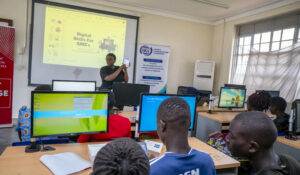
Youth and women digital skilling: Over 15,000 youth groups have received ICT and multimedia training, empowering them to create employment. More than 50,000 women in the informal sector have been skilled, narrowing the gender digital gap and enabling socio‑economic participation.
- E‑agriculture adoption: Pilot interventions such as the ICT4Farmer app have reached 20,000 farmers, improving productivity, information access and digital skills among smallholder farmers.
- Support for PWDs: Deployment of specialised e‑learning technologies to PWD schools, provision of assistive ICT devices, including braille embossers in partnership with the National Union of Women with Disabilities of Uganda (NUWODU), and capacity building training of over 1,500 girls and women with audio and visual disabilities across 50 districts.
- Device project for low‑income households: Over 10,000 solar‑powered, data‑enabled smart devices have been distributed to households in more than 30 districts, accompanied by basic training in digital literacy, stimulating uptake of e‑education, e‑agriculture and e-government services while narrowing the digital divide.
Strengthening international engagement and standards
- Strategic global representation: UCC coordinates Uganda’s active participation in the global ICT sector governance ecosystem, contributing to high level policy and governance, as well as aligning with international standards and best practices. Uganda is one of the 13 African countries on the 48‑member ITU Council (2023-2026), as well as a member of the Universal Postal Union (UPU) Administrative Council (2025-2029), among other roles. In addition, at the 11th Ordinary Session of the Pan African Postal Union (PAPU) Plenipotentiary Conference held in Kampala in March 2026, Uganda assumed the chairmanship of the PAPU Plenipotentiary Conference for the 2026–2030 cycle. The meeting also saw Ugandan national Jessica Ssengooba re-elected Assistant Secretary of PAPU.
- Technical standards leadership: UCC has provided expert technical inputs to global standards development processes across telecommunication, broadcasting, postal services, cybersecurity, digital finance and audio-visual sectors, ensuring Uganda’s voice in shaping the global ICT agenda.
- Hub for global dialogue: In 2024, Uganda hosted the ITU Global Symposium for Regulators (GSR‑24), attracting over 600 international delegates from more than 75 countries to deliberate on regulatory trends and best practices.

Conclusion
The Uganda Communications Commission continues to implement interventions across infrastructure development, policy reform, consumer protection, skills development, content industry enhancement, and international collaboration. These efforts are playing a significant role in shaping Uganda’s digital economy and advancing economic growth and development in line with the NRM Manifesto and the Fourth National Development Plan (NDP IV).

Related Posts