OKULABULA KU NKOZESA Y’EMIKUTU GY’EMPULIZIGANYA EMBI Ekitongole ekilungamya eby’empuliziganya mu ggwanga (Uganda Communications Commission) kyagala…
UCC Study Highlights Strong Impact of ICT4PWD Programme

KAMPALA, February 11, 2026– A new impact assessment commissioned by the Uganda Communications Commission has found that the ICT for Persons with Disabilities Programme under the Uganda Communications Universal Service and Access Fund (UCUSAF) has significantly expanded digital inclusion for persons with disabilities (PWDs) across Uganda and delivered meaningful socio-economic benefits.
The assessment report, prepared by Radix Management Consulting, concludes that while the ICT4PWD programme has made notable progress, sustaining and scaling its gains will require targeted support for underserved disability groups, longer training cycles, improved connectivity, and deeper integration into government systems.
UCUSAF, whose mandate rotates around promoting equitable access to ICT services in underserved areas, has over successive programme cycles (I–IV) supported major national initiatives in ICT infrastructure, ICT in education, ICT4Health, and the flagship ICT4PWD programme. The latter was designed to address the needs of the estimated 16 percent of Ugandans living with disabilities.
Recognising the transformative potential of ICT in improving socio-economic outcomes, UCC partnered with key stakeholders, including National Union of Women with Disabilities of Uganda (NUWODU), National Union of Disabled Persons of Uganda (NUDIPU), and Eight Tech Consults to implement a range of interventions. These included digital literacy initiatives for girls and women, provision of assistive technologies to secondary schools and regional hubs, as well as a three-year pilot programme promoting digital inclusion for PWDs.
Given the scale of investment and the programme’s growing footprint, UCC commissioned the study to evaluate how effectively ICT4PWD interventions were translating into tangible outcomes for beneficiaries, particularly persons with disabilities, their organisations, local governments, implementing partners, and other ecosystem actors.
The four-month assessment covered the regions of Central, Eastern, Northern, Western, and West Nile, focusing on 73 out of Uganda’s 135 districts (54.1 percent) where interventions were most active.
The assessment report, which was subjected to stakeholder validation at the UCC head office, focused on three core projects: ICT for Persons with Disabilities, Digital Literacy for Girls and Women, and provision of assistive technology devices to secondary schools and regional hubs. It examined relevance, effectiveness, efficiency, sustainability, and overall outcomes.
Findings show that key outputs such as assistive technologies, digital skilling, the ICT4PWD Observatory, digital platforms for organisations of persons with disabilities (OPDs), and capacity-building initiatives were broadly relevant to beneficiary needs and aligned with national development priorities, including the National Development Plan III, Vision 2040, and the Sustainable Development Goals (SDGs).
The report highlights strong evidence of improved learning outcomes, greater participation in education and community life, increased digital inclusion, and enhanced empowerment among PWDs. Teachers and implementers reported improved learner independence, reduced stigma, and expanded social and economic participation.
Stakeholders across UCC, district local governments, ministries, and implementing partners affirmed that the programme complements government and NGO initiatives in digital transformation, inclusive education, and socio-economic empowerment.
Persistent Barriers Remain
Despite the positive outcomes, the report identifies several constraints limiting optimal utilisation of programme outputs. These include limited numbers of devices and assistive technologies, uneven distribution of assistive tools, unstable or costly internet connectivity, and persistent low levels of digital literacy among different disability groups.
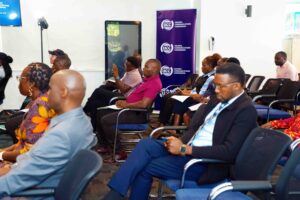
Other challenges cited include short training durations, inadequate post-training follow-up, gaps in instructor preparedness, low usage of the ICT4PWD Observatory, and weak digital capacity among some OPDs. Uneven inclusion across disability groups, particularly the deaf and persons with intellectual disabilities was also noted.
While implementing partners reported working under stretched budgets, staffing, and time constraints, frontline feedback from teachers and beneficiaries generally indicated timely and effective delivery. However, some schools and participants experienced gaps in consistency, reach, and logistical support.
To mitigate challenges, implementing teams adopted several adaptive strategies, including hybrid and localised training models, training-of-trainers (ToT) approaches, inclusive communication practices, technical workarounds for connectivity issues, and practical measures such as device protection protocols and targeted mobilisation.
The report recommends that continuous capacity building should be prioritised through modular training pathways that progress from basic to advanced ICT and assistive technology skills, complemented by refresher sessions, peer-learning models, and ongoing mentorship anchored in community digital hubs. It calls for the strengthening of inclusive delivery through adapted materials, sign-language digitization and assistive technology champions in schools, supported by regular maintenance and technical backstopping. The report further recommends popularizing of the Digital Observatory as a key resource centre, expanding access to accessible devices, subsidised data for low-income persons with disabilities, and improved rural connectivity to close persistent digital gaps.
The assessment provides a critical evidence base to guide future interventions under UCUSAF and deepen Uganda’s commitment to inclusive digital transformation, ensuring that no one, particularly PWDs, is left behind in the digital age.
Related Posts